
Introduction
A study plan is a simple system that helps you study in the right way. It tells you what to study, when to study, and what to revise. Many students study for long hours but still feel confused. This happens when study time has no clear structure. When you follow a plan, you reduce stress and improve focus. You also become more consistent, and consistency is what brings real results.
A good plan does not need to be strict. It should be easy to follow and flexible. It should include learning, practice, and revision. It should also include rest because rest supports memory and focus.
What a Study Plan Is
A study plan is a schedule that breaks big topics into small tasks. It includes:
- New learning (chapters or topics)
- Practice (questions and exercises)
- Revision (review after gaps)
- Weekly testing (past paper or mock)
This structure makes your study time productive. It also keeps you on track when you feel lazy or busy.
How to Create a Study Plan (Step-by-Step)
Step 1: Write Your Subjects and Topics
List all subjects. Then list chapters or units. Mark each topic as:
- Easy
- Medium
- Hard
This helps you give more time to difficult topics.
Step 2: Set Weekly Goals
Weekly goals keep your plan realistic. Example:
- Finish 2 chapters
- Solve 150 questions
- Do 1 past paper
Step 3: Break Goals into Daily Tasks
Each day should have:
- One learning task
- One practice task
- One short revision task
Small daily tasks are easier to follow than big tasks.
Step 4: Choose Study Blocks
Use short sessions so you stay focused:
- 25 minutes study + 5 minutes break
- 45 minutes study + 10 minutes break
Short sessions reduce burnout and improve attention.
Step 5: Add Revision on Purpose
Do not keep revision for the end. Add revision daily and weekly. This improves memory and exam performance.
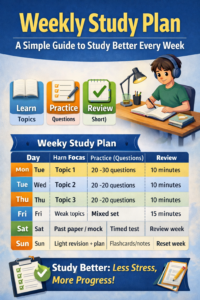
Weekly Study Plan Template (Quick View)
Use this basic weekly structure:
| Day | Learn | Practice | Revision |
|---|---|---|---|
| Mon | Topic A | 20–30 questions | 10 mins |
| Tue | Topic B | 20–30 questions | 10 mins |
| Wed | Topic A | 20–30 questions | 10 mins |
| Thu | Topic C | 20–30 questions | 10 mins |
| Fri | Weak areas | Mixed set | 15 mins |
| Sat | Past paper / mock | Timed test | Error review |
| Sun | Light revision | Flashcards | Plan week |
👉 For a full weekly guide and variations, read Weekly Study Plan (internal link).
Best Study Methods to Use
Active Recall
Try to remember without looking at notes. Examples:
- Explain the topic aloud
- Write what you remember
- Use flashcards
- Answer short questions
Spaced Repetition
Revise after gaps to stop forgetting:
- Day 1 learn
- Day 3 quick review
- Day 7 review + questions
- Day 14 review again
Practice Questions
Do questions daily. Check mistakes carefully. Mistakes show you what to fix.
👉 For a student-focused routine, read Study Plan for Students
Revision Strategy (Simple and Effective)
Daily Revision (10–20 minutes)
- Quick recap
- Key points
- 5 short questions
Weekly Revision (1 longer session)
- Review weak topics
- Mixed questions
- Mistake notebook review
Before Exams
- More past papers
- Timed tests
- Deep mistake correction
👉 For exam timing and final weeks, read Study Plan for Exam (internal link).
Common Mistakes to Avoid
- Planning too much in one day
- Studying without practice questions
- Revising only at the end
- Using phone during study blocks
- Not tracking weak areas
- Quitting after missing one day
FAQs (7 Questions)
- What is a study plan?
- How many hours should I study daily?
- How do I make a weekly plan?
- How do I revise properly?
- What study method is best?
- What if I miss a day?
- How do I stay consistent?
Conclusion
A study plan is your study system. It makes your work clear and manageable. Keep it simple. Study in short blocks. Practise questions regularly. Revise with gaps. Test yourself weekly. If you follow this routine for 2–3 weeks, you will feel more confident and more prepared.