A weekly study plan is a practical way to organise your week so you study with less stress and better results. Instead of waking up daily and guessing what to do, you plan your week once, then follow small tasks each day. This approach works well for students because real life is busy. School, homework, tuition, chores, and fatigue can disturb strict daily timetables. Weekly planning gives you structure, but also gives you flexibility.
This guide is written in simple English and an educational tone. You will learn what a weekly plan looks like, how to create one step by step, where to fit study time, what study methods save time, how to revise properly, what mistakes to avoid, and how to adjust when exams are close. You will also find a template, FAQs, and a clear conclusion.
What This Plan Looks Like
A weekly plan is not just “study 3 hours daily.” It is a balanced mix of four things:
- Learning: understanding new topics
- Practice: solving questions
- Review: remembering what you studied
- Testing: checking progress once a week
When these four parts are included, your study becomes complete. You do not only “read.” You learn, apply, remember, and improve.
A good plan should be:
- Easy to follow
- Small enough to complete daily
- Flexible enough to adjust
- Focused on progress, not perfection
Why Weekly Planning Works
Weekly planning works because it matches student life. Many students fail with strict daily schedules. They plan too much, miss one day, then quit. A weekly approach keeps the goal alive even if a day goes wrong.
Here are the main reasons it helps:
- Less stress: you stop daily confusion
- Better focus: you know exactly what to do
- More consistency: small tasks feel doable
- Better memory: revision becomes a planned habit
- Better marks: practice questions become regular
- Better balance: all subjects get attention
Even if you can study only 60–90 minutes daily, a weekly plan still works because it uses time wisely.
Who This Approach Helps Most
This structure fits many types of learners:
- School students who need routine and quick revision
- College students who need deeper understanding and longer sessions
- Busy students who have tuition, part-time work, or family duties
- Students who procrastinate because they don’t know where to start
- Students preparing for tests who need regular practice and weekly checks
If you feel behind, the solution is often not studying more. It is studying with a clear plan.
How to Build Your Week Step by Step
List your subjects and topics
Write all subjects on one page. Under each subject, list chapters or units. If you have a syllabus, follow it. If not, use your book index.
Now mark each topic as:
- Easy
- Medium
- Hard
This is important because harder topics need more time and more revision.
Pick weekly goals
Weekly goals should be clear and realistic. Examples:
- Finish 2 chapters
- Solve 120 questions
- Complete 1 past paper
- Revise 3 old topics
Avoid goals like “study a lot.” Clear goals are easier to complete.
Break goals into daily tasks
Now split your weekly goals across the week. Each day should have:
- One learning task (small)
- One practice task (small)
- A short review task (10–15 minutes)
This keeps the week balanced. It also keeps daily pressure low.
Add one buffer day
A buffer day is a light day where you can:
- Catch up missed tasks
- Focus on weak areas
- Do extra practice
Most students need a buffer day because life is unpredictable.
Track progress in one place
Use a simple checklist:
- Topic studied ✅
- Questions done ✅
- Review done ✅
- Mistakes noted ✅
Tracking makes you feel progress. It also shows you what needs improvement.
Where to Place Study Time in a Busy Day
Your plan will fail if it does not match your routine. So choose a time you can repeat daily.
Good time options:
- After school: strong focus, less delay
- Evening: calm time if home is quiet
- Early morning: best for memory if you are fresh
Avoid planning heavy study when:
- You feel sleepy
- You are always interrupted
- You are hungry or tired
A simple daily structure (easy for most students)
- Learning: 45 minutes
- Break: 10 minutes
- Practice: 45 minutes
- Short review: 10–15 minutes
Busy day version:
- Learning: 25 minutes
- Practice: 25 minutes
- Review: 10 minutes
Consistency matters more than long hours.
A Simple Weekly Template You Can Copy
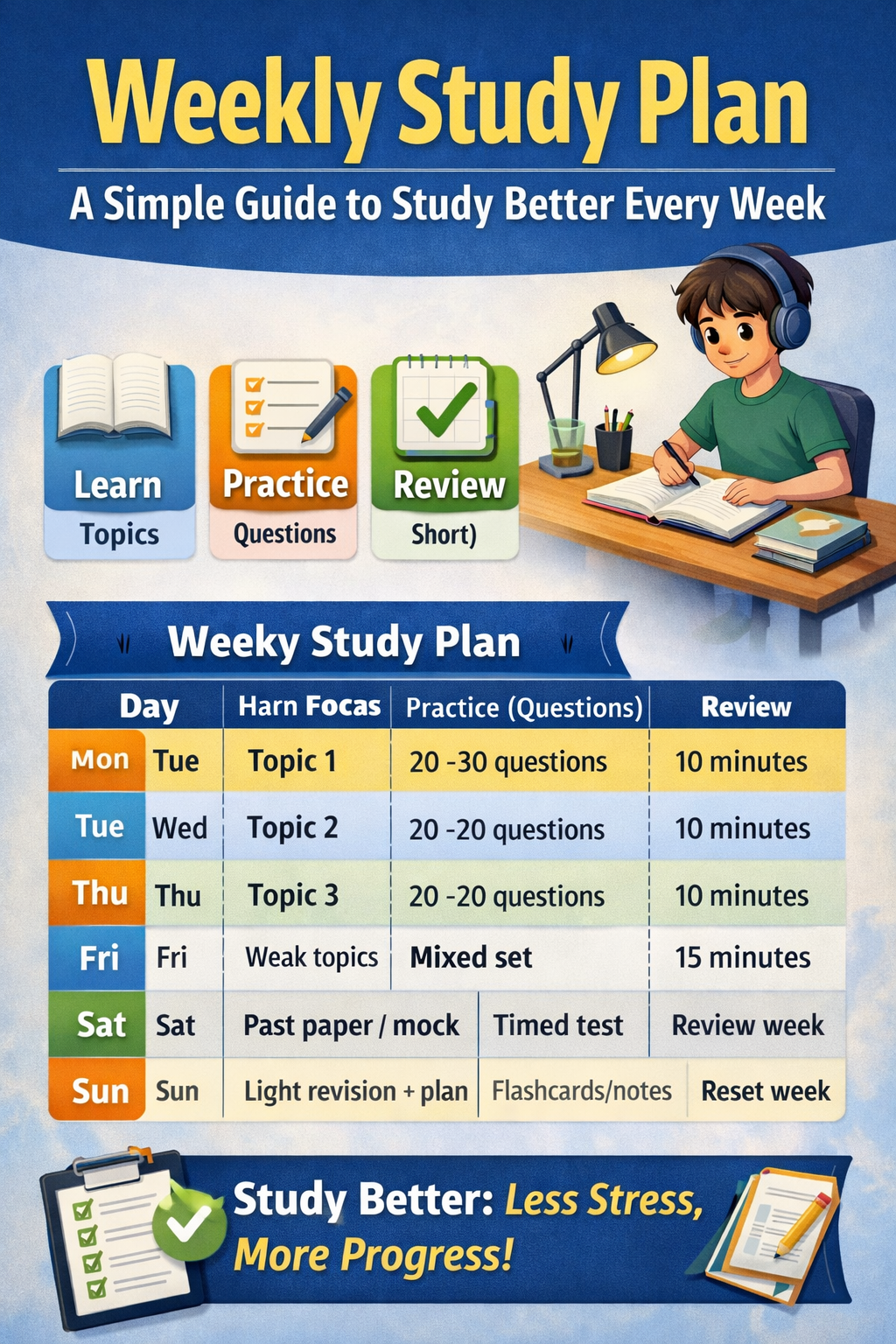
Use this as your starting point. Adjust later based on your subjects.
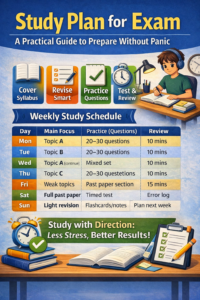
| Day | Main Focus | Practice | Short Review |
|---|---|---|---|
| Monday | Topic 1 | 20 questions | 10 minutes |
| Tuesday | Topic 2 | 20 questions | 10 minutes |
| Wednesday | Topic 1 (continue) | 20 questions | 10 minutes |
| Thursday | Topic 3 | 20 questions | 10 minutes |
| Friday | Weak topics | Mixed set | 15 minutes |
| Saturday | Past paper / mock | Timed test | Review mistakes |
| Sunday | Light revision + plan | Flashcards/notes | Reset week |
Why this template works:
- It gives you repeatable structure
- It keeps practice daily
- It includes a weekly test
- It includes a reset day
Smart Study Methods That Save Time
Many students waste time with passive study. Passive study means reading again and again without testing yourself. It feels safe, but it is slow.
Use these smarter methods.
Recall first, then read
Before you read a topic, ask:
- What do I already know?
- Can I explain it in simple words?
After reading, close the book and recall again. This turns learning into memory.
Review with gaps
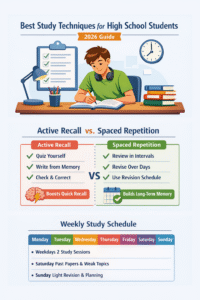
If you learn something today and never return, you will forget. Gapped review (spaced repetition) stops forgetting.
A simple schedule:
- Day 1: learn
- Day 3: quick review
- Day 7: review + questions
- Day 14: quick review again
This method is powerful and safe. It is not a trick. It is a proven learning habit.
Learn from mistakes
Mistakes are not failure. Mistakes are feedback.
Keep a small “mistake list”:
- What I got wrong
- Why I got wrong
- Correct idea or method
- One similar example
Review this list weekly. It improves marks faster than re-reading notes.
How to Review Without Forgetting
Review should be planned inside your week. If you leave revision for the end, you will panic and forget.
Daily short review (10–15 minutes)
At the end of study:
- Recall key points
- Answer 5 quick questions
- Read your own short summary
This makes later revision easier.
Weekly review session (30–60 minutes)
Once a week:
- Review weak topics
- Re-do wrong questions
- Do a mixed quiz
This builds stability.
Monthly check (optional but helpful)
Once per month:
- One full mock test
- Full mistake review
- Update weak topic list
How to Practise Questions the Right Way
Practice builds exam skill. But practice must be done correctly.
The 4-step practice method
- Attempt questions without help
- Check answers
- Understand mistakes
- Repeat similar questions later
How many questions are enough?
Start small so you can stay consistent:
- 15–25 MCQs daily, or
- 8–12 numericals daily, or
- 2–3 long questions daily
What to do when you get many wrong answers
Do not panic. Wrong answers show gaps. Fix them like this:
- Re-learn the concept briefly
- Write the correct method
- Do 2 similar questions
That is real improvement.
Benefits You’ll Notice in Two Weeks
If you follow this plan for 14 days, many students notice:
- More clarity and less stress
- Better focus during study time
- Better memory because review is regular
- Faster problem-solving due to daily practice
- Better confidence because of weekly testing
Small daily actions create big results over time.
Disadvantages and How to Fix Them
Weekly planning is strong, but it has a few risks if done badly.
Disadvantage 1: You may over-plan
Fix: Keep tasks small. Plan what you can finish, not what looks impressive.
Disadvantage 2: It can feel repetitive
Fix: Rotate subjects and change study style sometimes. Add quizzes, flashcards, or group discussion.
Disadvantage 3: Students skip the review part
Fix: Treat review as a must. Keep it short. Do not make it heavy.
Disadvantage 4: You may ignore weak topics
Fix: Use Friday or a buffer day for weak topics. That is why weak-day exists.
Common Mistakes to Avoid
Here are common errors that reduce results:
- Studying only by reading notes
- Not practising questions daily
- Not reviewing mistakes
- Planning too many subjects in one day
- Using phone during study blocks
- Sleeping late and losing focus
- Quitting after one missed day
A weekly plan works when you keep it simple and repeatable.

When Exams Are Close: What to Change
When exams are near, your weekly plan should shift. You spend less time learning new topics and more time on testing and review.
More timed practice
Do timed question sets. Learn to manage time.
More past papers
Past papers teach you patterns and common questions.
Faster revision
Use:
- Short notes
- Flashcards
- Mistake lists
- Key formulas and definitions
A simple exam-week adjustment
- 2 days: heavy past paper practice
- 2 days: weak topic fix + questions
- 2 days: revision rounds
- 1 day: light recap + sleep focus
You can link this section to your supporting post about exam preparation: study plan for exam
FAQs
1) How many hours should I study each week?
It depends on your goals and class level. Many students improve with 10–20 focused hours weekly. If you are very busy, even 7–10 hours weekly can work if practice and review are consistent.
2) What should I include in my weekly schedule?
Include learning, practice questions, short review, and one weekly test. This combination builds understanding, skill, and memory.
3) What if I miss one day?
Do not quit. Move the task to your buffer day or weekend. Weekly planning is flexible, so missing a day is not the end.
4) How do I stop forgetting what I study?
Use short daily review and spaced revision with gaps. Also use recall-based study instead of only reading.
5) Is it better to plan daily or weekly?
Weekly planning is easier for many students because it is flexible and reduces stress. You can still use daily tasks inside the weekly plan.
6) How can I stay consistent without motivation?
Make tasks small, study at the same time daily, and use a checklist. Consistency grows when the routine feels easy to start.
7) Should I study one subject per day or multiple subjects?
Both can work. Many students do well with one main subject plus a short review for a second subject. Choose the format that fits your energy and timetable.
Conclusion
A weekly study plan helps you study with clarity and confidence. It gives you structure without strict pressure. It balances learning, practice, review, and testing. Start with a simple template, keep tasks small, and track mistakes weekly. After two weeks, you will feel more organised and more prepared. Over time, your marks improve because your study becomes consistent and smart.