
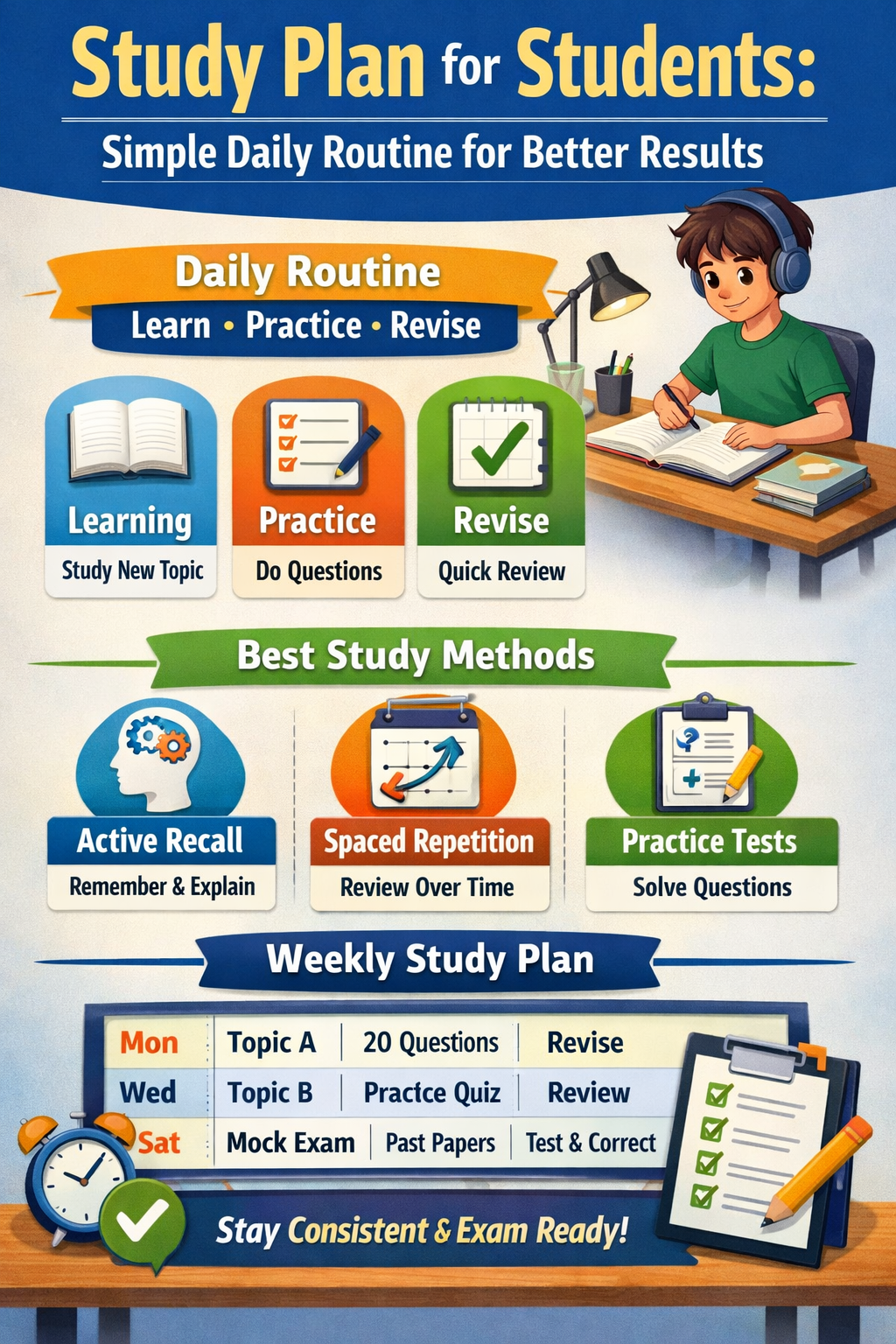
A study plan for students is not a strict timetable that makes you feel trapped. It is a simple routine that helps you stay on track, cover your subjects, and revise at the right time. Many students study for long hours but still feel behind. This happens because they study without structure. They read notes again and again, but they do not practise enough and they revise too late.
This guide gives you a daily routine that fits real student life. It works for school and college. It also works if you have tuition, homework, or a busy schedule. The routine is built around three simple parts: learning, practice, and revision. When you follow these steps, you study with clarity. You also improve your memory, confidence, and results.
What a Study Plan for Students Means
A study plan is a system that helps you decide:
- What to study today
- What questions to practise today
- What to revise today
- How to track weak areas
- When to test yourself
It is not only about time. It is also about the method you use. If your routine has time but no method, progress becomes slow. When you add practice and revision, results improve faster.
Why Students Need a Clear Routine
A daily routine helps you because it:
- Reduces last-minute panic
- Builds consistency and discipline
- Improves memory through daily review
- Increases marks through practice questions
- Helps you manage multiple subjects
- Makes studying feel less stressful
When your tasks are written, your mind feels lighter. You stop thinking, “What should I study now?” and you start doing the work.
How to Build a Simple Study Plan (Step-by-Step)
Step 1: List Your Subjects and Topics
Write all subjects. Then list chapters or units. Use your syllabus or textbook index. Mark topics as easy, medium, or hard so you can give more time to difficult areas.
Step 2: Set Weekly Targets
Weekly targets are flexible and realistic. Examples:
- Finish 2 chapters this week
- Solve 150–200 questions this week
- Complete 1 past paper and review it
Step 3: Break Weekly Targets Into Daily Tasks
Each day should have one small target. Example:
- Learn one topic section
- Practise 15–25 questions
- Revise for 10–15 minutes
Step 4: Choose Your Best Study Time
Pick a time when you can focus. Many students do well after school or in the evening. Choose a time with fewer interruptions.
Step 5: Use Study Blocks
Study blocks help you focus without burnout:
- 25 minutes study + 5 minutes break
- 45 minutes study + 10 minutes break
- 60 minutes study + 15 minutes break (only if you focus well)
The Daily Routine (3-Part Formula)
This is the routine you repeat daily.
Part 1: Learning Block (New Topic)
Focus on understanding.
What to do:
- Read the topic from textbook or notes
- Write key points in your own words
- Make a short summary (5–7 lines)
- Create 5–10 short questions from the topic
Time idea: 30–60 minutes.
Part 2: Practice Block (Questions)
Practice builds marks and skill.
What to practise:
- MCQs
- Short questions
- Numericals
- Past paper questions
How much to do daily:
- 15–25 MCQs, or
- 8–12 numericals, or
- 2–3 long questions
Golden rule: Review wrong answers, write why the mistake happened, fix it, then try a similar question.
Part 3: Quick Revision (Short Recap)
This protects memory in just 10–15 minutes.
What to do:
- Review your summary
- Answer your self-made questions without looking
- Recall key points aloud
- Note 2–3 weak points for later revision
Best Study Methods to Use
Active Recall (Best for Memory)
Active recall means you try to remember without reading.
Easy methods:
- Close the book and explain the topic
- Write what you remember on a blank page
- Use flashcards
- Answer your self-made questions
Spaced Repetition (Best for Long-Term Recall)
Spaced repetition means revising after gaps.
Simple routine:
- Day 1: Learn
- Day 3: Quick revision
- Day 7: Revision + questions
- Day 14: Quick revision again
Practice Questions (Best for Exam Speed)
Practice questions build exam skills.
Best approach:
- Attempt
- Check
- Fix mistakes
- Repeat similar questions later
Weekly Template (Simple and Flexible)
| Day | Main Focus | Practice | Revision |
|---|---|---|---|
| Monday | Topic A | 20 questions | 10 mins |
| Tuesday | Topic B | 20 questions | 10 mins |
| Wednesday | Topic A (continue) | 20 questions | 10 mins |
| Thursday | Topic C | 20 questions | 10 mins |
| Friday | Weak areas | Mixed set | 15 mins |
| Saturday | Past paper / mock | Timed test | Error review |
| Sunday | Light revision + plan | Flashcards | Reset |
How to use it:
- Rotate 2–3 main subjects
- Keep Saturday for testing
- Keep Sunday light to avoid burnout
- Use Friday for weak topics
Revision Strategy for Students
Daily Revision
10–15 minutes:
- Quick recap
- Key points
- A few recall questions
Weekly Revision
Once per week:
- Review weak topics
- Re-do wrong questions
- Take a mixed quiz
Final Revision Before Exams
Before exams:
- Focus on past papers
- Time yourself
- Review mistakes deeply
- Use summaries instead of full chapters
Common Mistakes Students Make (And Easy Fixes)
Mistake 1: Planning Too Much
Fix: Use smaller daily tasks and weekly targets.
Mistake 2: Only Reading Notes
Fix: Add practice questions daily.
Mistake 3: Revising Only at the End
Fix: Use quick daily revision and spaced repetition.
Mistake 4: Phone Distractions
Fix: Keep the phone away during study blocks.
Mistake 5: Quitting After One Bad Day
Fix: Continue the next day. Adjust the plan, do not leave it.

FAQs (7 Questions)
1) How many hours should students study daily?
Most students improve with 2–4 focused hours. If you are busy, even 60–90 minutes daily can work with consistency.
2) What is the easiest daily routine for students?
One learning block, one practice block, and one short recap is simple and effective.
3) How can I study with tuition and homework?
Use shorter blocks. Study one topic section, do a small question set, and finish with a quick recap.
4) Which method improves memory the most?
Active recall is one of the strongest methods because it trains your brain to retrieve information.
5) How do I revise without getting bored?
Revise using questions, flashcards, and short quizzes. Avoid only reading.
6) Should I study one subject or multiple subjects per day?
Both work. Many students do well with one main subject and one lighter subject for revision.
7) What should I do if I keep making mistakes in practice?
Keep a mistake notebook. Write the mistake, the correct method, and practise similar questions later.
Conclusion
A study plan for students works best when it is simple and consistent. Follow a daily routine that includes learning, practice, and a short recap. Use active recall to improve memory. Use practice questions to improve exam performance. Use spaced repetition to stop forgetting. Track mistakes weekly and keep tasks small so you do not quit. If you follow this routine for a few weeks, you will feel more confident and more prepared.