Exams feel stressful when your study is unclear. You may sit with books for hours, but still feel unprepared. That usually happens for one reason: you don’t have a clear system. A study plan for exam preparation gives you direction. It helps you decide what to study first, how to revise, how to practise questions, and how to use your time wisely.
This guide is made for students who want a simple, realistic plan. It is written in short paragraphs and simple English. It covers what an exam plan is, why it works, how to build one step by step, where to fit it in your day, the benefits and disadvantages, revision strategy, common mistakes, and FAQs.
👉 For the full foundation system, visit Study Plan (internal link).
What an Exam Study Plan Really Means
A study plan for exam is a structure that helps you:
- Cover the syllabus in the right order
- Revise before you forget
- Practise questions regularly
- Improve speed and accuracy
- Track weak topics
- Reduce last-minute pressure
It is not a “study all day” schedule. It is a smart routine that balances learning and practice. It also includes review time, because memory needs repetition.
Why This Kind of Planning Works
An exam plan works because it removes guesswork. When your tasks are written, your mind becomes calmer. You stop wasting time deciding what to do next. You also reduce procrastination because you have small clear steps.
Here are the main reasons it works:
- It makes big syllabus feel manageable
- It keeps you consistent with small daily tasks
- It builds confidence through regular testing
- It improves memory through planned revision
- It helps you focus on weak areas early
Most students don’t fail because they are not smart. They struggle because they revise too late and practise too little.
Who Should Use This Plan
This guide fits:
- Students preparing for school exams
- College students preparing for midterms or finals
- Students doing board exams
- Students preparing for entry tests or competitive exams
- Students who feel “I studied, but I forgot”
If you are a student who gets stressed near exams, this plan will help you organise your time and calm your mind.
How to Build a Study Plan for Exam Step by Step
Step 1: Confirm your exam dates and subjects
Write:
- Exam start date
- Subjects
- Number of chapters/topics per subject
Now count the days you have. This will decide your pace.
Step 2: Split your time into 3 phases
A simple exam preparation structure is:
Phase A: Coverage (learn + basic practice)
Goal: finish topics and understand concepts.
Phase B: Revision (review + mixed questions)
Goal: strengthen memory and fix weak areas.
Phase C: Testing (past papers + timed practice)
Goal: improve speed, accuracy, and confidence.
If your exam is near, you will spend more time in Phase B and C.
Step 3: Decide your study time blocks
Use focus blocks, not long hours.
Good options:
- 25 minutes study + 5 minutes break
- 45 minutes study + 10 minutes break
- 60 minutes study + 15 minutes break (only if you focus well)
Short blocks reduce burnout and help you stay consistent.
Step 4: Choose the order of topics
Do not study randomly. Use this order:
- High weight topics (frequently asked)
- Medium weight topics
- Low weight topics
- Weak topics (give them extra review time)
If you don’t know topic weight, use past papers. They show what repeats.
Step 5: Add practice and revision from day one
Many students delay practice. That is a mistake. Add practice daily, even if small. Add revision daily, even if short.
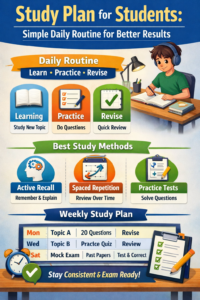
A simple daily structure:
- Learn (new topic)
- Practise (questions)
- Review (short recap)
This structure matches the “study plan for students” style routine and helps you avoid panic later.
Where to Fit Your Exam Study Plan in a Busy Day
The best plan is the one you can follow consistently.
Good time options:
- After school (strong for most students)
- Evening (quiet time if home is calm)
- Early morning (great for memory if you wake up fresh)
Avoid planning heavy study when:
- You are always sleepy
- You are constantly interrupted
- You have no breaks
A realistic daily routine (2–3 hours)
- 45 minutes: learning
- 10 minutes: break
- 45 minutes: practice
- 10–15 minutes: short recap
- Optional: 20 minutes for weak-topic review
A busy-day routine (60–90 minutes)
- 25 minutes: learning
- 25 minutes: practice
- 10 minutes: recap
Busy days are normal. A smaller routine is better than skipping.
How to Use Smart Study Methods for Exam Success
This section is important because it improves results without adding extra hours.
Active recall
Active recall means you try to remember without looking at notes.
Simple ways:
- Close the book and explain the topic
- Write key points from memory
- Ask yourself questions
- Use flashcards
Why it helps: Exams test recall, not reading. Active recall trains exam skill.
Spaced repetition
Spaced repetition means you revise after gaps so you don’t forget.
Simple schedule:
- Day 1: learn
- Day 3: quick review
- Day 7: review + questions
- Day 14: quick review again
Why it helps: Your brain forgets quickly if you don’t return. Spacing fixes that.
Practice questions and past papers
Practice is where marks grow. Past papers show exam patterns.
Best practice routine:
- Attempt
- Check
- Understand mistakes
- Repeat similar questions later
Do not just mark wrong answers. Fix them.
A Weekly Template for Exam Preparation
Even during exam prep, weekly planning is useful because it keeps balance and flexibility. (This also supports internal linking with your weekly study plan content.)
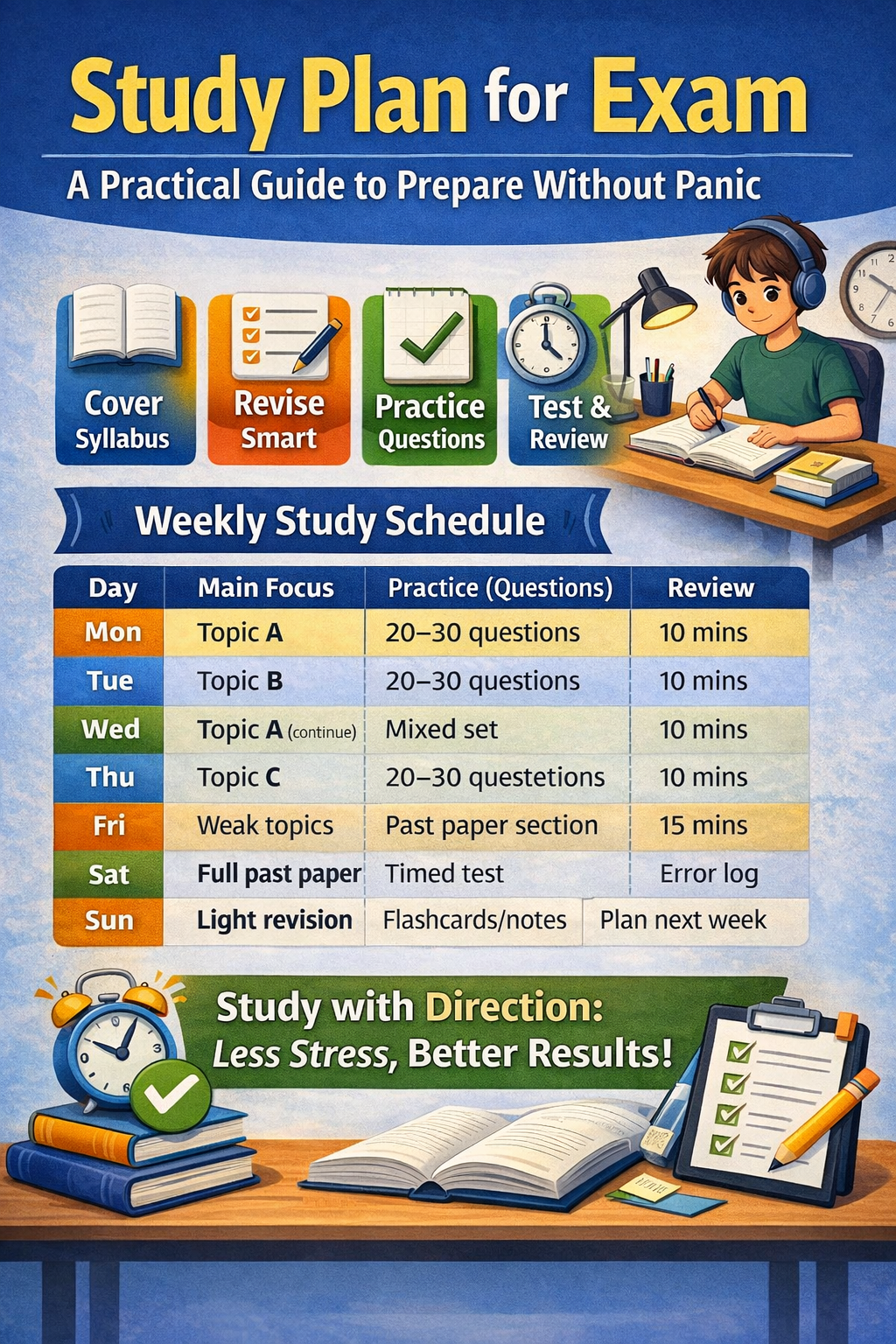
Use this simple weekly pattern:
| Day | Main Focus | Practice | Review |
|---|---|---|---|
| Mon | Topic A | 20–30 questions | 10 mins |
| Tue | Topic B | 20–30 questions | 10 mins |
| Wed | Topic A (continue) | Mixed set | 10 mins |
| Thu | Topic C | 20–30 questions | 10 mins |
| Fri | Weak topics | Past paper section | 15 mins |
| Sat | Full past paper | Timed test | Error log |
| Sun | Light revision | Flashcards/notes | Plan next week |
This template keeps your week stable. It also makes sure you practise and revise regularly.
The Best Revision Strategy Before Exams
Revision should be planned. Not emotional. Not last-minute.
Daily revision (10–20 minutes)
At the end of your session:
- Recap key points
- Do 5 quick recall questions
- Review your short notes
This prevents forgetting.
Weekly revision (1 longer session)
Once a week:
- Review weak topics
- Re-do wrong questions
- Take a short quiz
This builds confidence.
The “three-round revision” approach
This is simple and effective:
- Round 1: basic review + easy questions
- Round 2: mixed questions + weak areas
- Round 3: past papers + timed practice
Most students revise only once. That is why they forget. Multiple rounds fix memory.
Exam Countdown Plans (Choose What Matches Your Time)
If you have 4 weeks
Week 1–2 (Coverage + practice):
- Finish major topics
- Daily questions
- Short daily recap
Week 3 (Revision + weak areas):
- Focus on difficult topics
- Mixed question sets
- Mistake notebook work
Week 4 (Testing + final revision):
- Past papers
- Timed practice
- Quick notes revision
If you have 2 weeks
- 60% time: revision + mixed practice
- 40% time: past papers + timed tests
- Daily: short recap + mistake correction
If you have 7 days
- Morning: revise topics (short notes)
- Evening: practice questions + past paper sections
- Daily: error review and redo weak question types
If you have 1 day
- Revise summaries only (not full chapters)
- Do a small set of common questions
- Review mistakes and key formulas
- Sleep early (this helps recall)
Benefits of a Study Plan for Exam
A good plan gives you:
- Clear direction each day
- Less stress and less panic
- Better memory due to planned revision
- Better marks due to practice and testing
- Better time management in exams
- Higher confidence because you track progress
Even if your syllabus is big, planning makes it manageable.
Disadvantages (And How to Fix Them)
Every plan can fail if it is made wrong.
Disadvantage 1: It can feel strict
Fix: Keep weekly goals flexible. Move tasks when needed.
Disadvantage 2: Students over-plan and burn out
Fix: Plan fewer tasks. Leave buffer time.
Disadvantage 3: Students skip practice
Fix: Make practice small but daily. Even 15 minutes helps.
Disadvantage 4: Students ignore mistakes
Fix: Keep a small error log. Review it weekly.
A plan is not about perfection. It is about progress.
Common Mistakes Students Make During Exam Prep
Avoid these mistakes because they waste time:
- Re-reading notes again and again
- Studying without solving questions
- Revising only in the last week
- Not timing practice
- Not reviewing wrong answers
- Studying new topics on the last night
- Sleeping too little and losing focus
If you fix just two of these, your results can improve quickly.
A Simple “Error Log” System (High Impact)
Keep one notebook page per subject:
- Topic name
- Mistake type (concept / formula / careless)
- Correct method
- One example question
- Date to re-try (after 3–7 days)
This is one of the fastest ways to improve marks because it targets your weak points.
How to Stay Consistent When Motivation Drops
Motivation is not reliable. A system is reliable.
Try these:
- Start with a 5-minute rule (just begin)
- Keep tasks small
- Use a checklist to tick progress
- Reward yourself after completion (short walk, snack, rest)
- Study at the same time daily
Consistency builds confidence. Confidence builds motivation.
FAQs
1) What is the best study plan for exam preparation?
The best plan includes learning, daily practice questions, short daily revision, and weekly past paper testing with mistake review.
2) How many hours should I study per day for exams?
It depends on your level and time left. Many students do well with 2–4 focused hours. Busy students can still improve with 60–90 minutes daily if they practise and revise properly.
3) How do I make a plan if my syllabus is too large?
Split it into weekly goals. Start with high-weight topics and weak topics. Add daily practice and short revision so you don’t forget.
4) What should I do if I keep forgetting what I study?
Use active recall and spaced repetition. Revise after gaps (Day 3, Day 7). Also practise questions regularly.
5) How important are past papers?
Very important. Past papers teach you question patterns, timing, and common topics. They also reduce exam fear.
6) What if I miss a study day?
Do not quit. Move the task to a buffer day or weekend. Weekly planning is flexible, so one missed day is normal.
7) Should I study new topics in the last 24 hours?
Usually no. Focus on revision, common questions, key formulas, and sleep. A calm brain recalls better than a tired brain.
Conclusion
A study plan for exam success is not about studying all day. It is about studying with direction. When you plan your week, practise questions daily, revise with gaps, and test yourself with past papers, you reduce stress and improve results. Keep your tasks small. Track mistakes. Adjust your plan when exams are close. Follow the system for two weeks and you will feel more confident, more organised, and more prepared.